The ‘Needs to Know’
Distance: 5.5 miles (8.9 km)
Time to walk: Roughly 2.5 hours
Difficulty: Mainly across arable fields & could be very muddy in winter. There are also numerous stiles, some of which are quite high & slippery when wet. There are also inquisitive but docile horses in the paddock at the start & end
Parking: Carefully & considerately on the main road only that runs through Grafton Underwood. Please DO NOT park in anywhere else such as side or private roads
Public toilets: None
Map of the route:

This walk starts in the beautiful village of Grafton Underwood, which lies about 6 miles to the east of Kettering
As you’ll see it’s a stunning village that’s worth a visit purely on its own & is a designated conservation area. There are many thatched properties that are separated by a beautiful stream that runs between them. As the name suggests, the village lies just under Rockingham Forest

If you’re a fan of the Bridget Jones novels by Helen Fielding then you’ll know that Grafton Underwood was Bridget’s childhood home

The village attracts many overseas visitors each year, mainly from the USA. The area north of the village was once home to RAF Grafton Underwood which was opened in 1941. The original runways were approximately 1,600 yards & 1,100 yards in length. However, these were unsuitable for the operation of heavy, four-engined bombers & the field was upgraded in late 1942
Grafton Underwood was the first airfield in England to be assigned the United States Army Air Forces 8th Air Force in 1942. The airfield became home to succession of Bomb Groups, including the 305th, 96th, & 384th, all equipped with B-17s. At its height over 3000 personnel were based there

The first & last bombs in World War II dropped by American planes flew from Grafton Underwood
Also Paul Tibbets who flew on that first raid was the Commanding Officer flying Enola Gay (named after his mother) which dropped the first atomic bomb on Hiroshima
Clark Gable was also stationed there & was a ‘regular’ in the Star pub in Geddington.
The RAF’s No. 236 Maintenance Unit occupied the airfield after the war, before being declared surplus to requirements in 1959. There’s now a memorial just outside the village on the Geddington road that sits at the end of the main runway which can still be clearly seen. The public is allowed access into the nearby woods where there are some derelict buildings. There is currently a heritage / renovation project underway

Before you begin the walk (incase of muddy boots at the end) I highly recommend visiting the church to see its wonderful memorial window with the inscription “This window is dedicated before God in remembrance of those who gave their lives for freedom during World War II while serving at Grafton Underwood (1942-1945), especially members of the 384th Bomb Group (H) of the United States 8th Air Force”

There’s such a wealth of history here so…
Let’s Walk!
1. Today’s walk starts at the double footpath sign on one of the small bridges over the stream alongside the main road running through Grafton Underwood…

Cross the stream & walk away from the road towards the paddock gate…

2. Pass through the smaller gate on the right side into the paddock…

…& walk up the right hand side. The beautiful large house across to the left is the old Rectory

3. At the top of the paddock carefully cross the stile into another field

This is where you may encounter the friendly horses. Keep close to the hedge on the left & walk to the top left corner of the paddock

4. In the corner there are two more stiles to negotiate…


After crossing the second stile, walk to the left hand side of the hedge in the above picture above. Walk slightly diagonally left across the field towards the trees ahead

5. On reaching the hedge pass through the gap…

& continue straight ahead, keeping to the left of the telegraph pole to the next hedge…

6. At the hedge pass through another gap…

…& keep going straight ahead towards the left edge of the copse & then continuing alongside it

7. The path now reaches a small road…

Look for a gap in the hedge just to the right over the road. Go through it & continue slightly diagonally right across the next field…

8. Cross the bridge through the next gap

Now head for the right side of the wood…

9. On reaching the wood walk straight ahead keeping the wood on your left. At the end ignore the first path on the left with the marker. Instead walk through the next gap in the left hedge

9. The path now heads slightly diagonally left towards the next hedge…

…where there’s a small bridge to cross…

10. Now head diagonally right…

…& at the end of this field pass through the gate, or climb the stile into the next one…

The route now is directly towards the largest tree…

11. On reaching the fence, walk through the gate, cross the small road & go through the gate on the other side…

Walk along the hedge keeping it on your right…

12. On reaching the corner climb the stile into the Boughton House Estate

You won’t see Boughton House on this walk & it’s really important that you keep to the footpath. The house is one of the seats of the Duke of Buccleuch & is famed for its beauty, its collections, & the fact it has survived virtually unchanged since the 17th century. While possessing a medieval core, its exterior evokes an opulent French chateau
Boughton House contains a comprehensive collection of art, furniture, tapestries, porcelain & carpets. Once a servants’ hall, located next to the kitchen, the armoury is now home to what many experts regard as one of the finest privately held armouries in the country
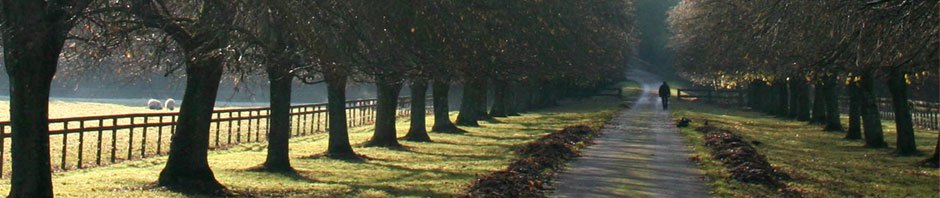
Our route heads diagonally left & into the magnificent Lime Tree Avenue…

The historic avenue of Lime trees on the Boughton Estate was originally planted around 1705 by the 2nd Duke of Montagu, with a combination of English elm & ‘Hatfield Tall’ lime trees. Hatfield Tall limes are a distinct type of lime tree commonly used in 17th & 18th-century planned gardens. The Duke became known as “John the Planter”

13. Take your time walking along this beautiful avenue – it really is rather special. If it’s still there, the path bears right away from the avenue just before the large fallen tree..

If the tree’s disappeared then look right to see a large tree &, to the right of it, a stile which is where the route continues


14. Carefully cross the stile & walk down the narrow path which eventually drops down & emerges at another gate & stile which you negotiate & “Welcome to Warkton”

You could just continue this walk by turning left & continuing the route up the hill, but Warkton is such a lovely little village, it’s worth a slight detour to explore. So why not carefully cross the road to the proper footpath & turn right down the hill…

15. Walk down the hill, passing the rather lovely village hall. The River Ise runs through the village at the bottom of the hill, but we’re not visiting it on this walk…

The village really does have some “chocolate box” properties

16. Turn left after the village hall & walk towards the church…

This is the beautiful church of St Edmund, particularly noted for containing four Baroque marble monuments erected between the 1750s & 1830s to members of the local Montagu family of Boughton House. The monuments are housed in four niches in the specially constructed chancel.

The church is locked to protect the monuments but they can be see by arrangement if you dial the number below

17. Continue past the church to the t-junction…

Another of my walks which also visits Weekley starts at this point. On this walk our route is to the left so follow the road past more stunning cottages as it bends left & up the hill

18. At the top of the hill this road rejoins the main road once more…

…so now turn right & be extremely careful. The next short part of this walk is along a busy road with no footpath so you have to keep jumping onto the verge

19. If you walk on the right side of the road you get some great views across the Ise Valley towards Kettering…

Continue straight ahead – do not turn down the road to the right. The road crosses Lime Tree Avenue once more…

20. After a short distance the road bends sharply left. At this point straight ahead is a gate. There is the remains of a footpath sign in the hedge, but it’s lost its fingerpost. Walk through the small gate into the field…

Walk straight across the field to another metal gate. The sheep did move eventually!

21. There’s a marker on the gate telling you to continue in the same direction…

You can see the next gate to the left of the large tree…

22. Once again the route remains straight, heading towards the right of the large tree in the picture below (the path drops down to it)…

Cross the gap & walk straight up the hill keeping the hedge on your left

23. At the top of the hill by the tree are two posts, presumably part of a former gate?

Pass through the posts & continue straight ahead with the hedge on your right towards the telegraph pole in the distance…

24. Walk ahead through the gap…

& turn immediately right. Walk to the corner & then turn immediately left & walk up the side of the field keeping the hedge on your right

25. At the top of the field are several paths, but turn left & continue in a straight direction

…to eventually arrive at a gate & a busy road so please be careful

26. Turn left & walk along the road, again jumping on the verge when traffic comes…

The road bends slightly left & right & then look for a gap in the hedge just after the large tree in the picture below…

27. Walk through the gap in the hedge & head diagonally right across the field, heading towards the left of the church spire…

On reaching the hedge continue left through the gap

28. In the next field, walk along the right side, keeping the hedge on your right…

…following it as it bends around the corner
29. This next field is the one you entered after crossing the double stile at the beginning of the walk at Point 4. Continue along the field edge in the same direction…

…to arrive at the stiles once more

30. Now it’s simply a case of retracing your steps back across the two horse paddocks to arrive back in the middle of Grafton Underwood once more
So that’s the end of this short, but quite remote walk. Much of the walk, as you’ve seen is across open fields & I’d reiterate that it will be muddy in winter, or after prolonged wet weather
However, if you like beautiful villages & walking without seeing another soul on field paths then this is definitely the one for you
Go Walk!