The ‘Needs to Know’
Distance: 5.66 miles (9.1km)
Time to walk: This took roughly 2.5 hours as it’s quite hilly in places, plus we stopped to take photos & eat our packed lunch
Difficulty: Pretty much all off road, across fields & woodland tracks. There are some hilly sections & be careful across rocks that may be slippery after rain. There are no stiles & dogs can be off lead for much of the walk
Parking: Car park at Heron Corn Mill. Cost £2 of cash into the honesty box which also allows you entry to have a look around the Mill. What3Words ‘pounce.rungs.crabmeat’
Public toilets: The Wheatsheaf Hotel in Beetham, if open, at the start & end of the walk but nothing in-between
Map of the route:

The walk covers a whole host of interesting features & magnificent views in Silverdale Arnside Area of Outstanding Natural Beauty. We first spent quite some time here in 2023 & have several amazing walks we’ve done already on this website
There’s an old mill, a Norman church, woodland, an ‘erratic’, a ruined fort, limestone pavements, red squirrels, a corpse road, Fairy Steps, a Ha-Ha, a fabulous house, red squirrels & parkland with fallow deer
The route provides outstanding views across the estuary to the Lake District fells & is a great walk for the family, not too steep & with plenty of interest for children
It’s simply fabulous so…
Let’s Walk!
1. This walk starts from the car park of Heron Corn Mill on the edge of the medieval village of Beetham. Heron Corn Mill is a working 18th century water mill on the River Bela. The mill & its race are Grade II listed &, in 2013, it was awarded a £939,000 grant from the Heritage Lottery Fund for major restoration work

(picture from Mill information board)
The mill is open to visitors, with regular opportunities to see flour being milled. The 18th century barn is used as a venue for a range of community & educational activities
A fish ladder bypassing the weir allows salmon to pass up the river to breed
The modern factory close by is a paper factory employing 140 people & producing 45,000 tonnes a year. There’s been a paper mill on the site since 1788 &, in 1964 it was the UK’s largest producer of ‘kraft’ paper
2. With your back to the entrance to the Mill, look across the car park to see a signpost & narrow path…

Follow this path alongside a stone wall. The views over the wall already give you an idea of the type of scenery that will unfold on this walk

3. Eventually the path reaches a narrow lane so please take care

Turn left & follow the lane towards Beetham. There’s an interesting sign on the gate on the left

4. Ignore all the paths going off to the left & right & continue into the village. On the left’s St Michael’s Church, the oldest existing part of which, the lower part of the tower, dates from the Anglo-Saxon era. The south aisle was added in about 1200, & the chancel was extended during the 13th century

Opposite’s The Old Post Office which is both a cafe & shop – look up to see the old bicycle. There’s a date above the door of 1881. As at 9/24 the cafe’s open Thursday – Saturday & Bank Holidays. If you want to explore the shop it’s ‘By appointment only, enquire in the cafe’

5. At the end of the lane’s the wonderful Wheatsheaf Hotel which dates back 400 years…

Turn right & then first left, passing the park on the right…

6. Just before the first house on the right follow the footpath down the side & the sign towards Hale…

There was cattle in this next field when we walked but they were very docile, even though we had a dog with us. Bear left & you can see the narrow grassy path heading slightly diagonally right up towards the wood

7. Look across to your left to see a large ‘erratic’. This is a large granite boulder that was transported here by glacial movement from the Shap Fells during the Ice Age. In medieval times farm tenants would gather here to pay their rents to the Lord of the Manor

Also to the left are the ruins of the fortified farmhouse at Beetham Hall…

The Hall dates from the 14th century, but was taken during the Civil War & left to ruin by the Parliamentarians
8. Keep heading in the same direction & pass through the ‘squeeze’ into the wood…

Follow the narrow path with the wall on your left. The stone walls in this area look stunning covered in moss

9. Pass through another ‘squeeze’ to emerge into the next field & carry on in the same direction…

Note the large stones on your right. These formed the boundary wall that enclosed Beetham Hall Deer Park

10. The path arrives at the top right corner of the field where there’s a fingerpost. Turn right on the path to Slackhead via Marble Quarry…

…& climb up the hill through the small gate

11. This is quite a large wood & there’s several paths going off in other directions so take your time & follow the directions – there are lots of way-markers. At the first of the markers take the path straight ahead…

…& then the next one…

…up through the boulders

12. Continue ahead following another wonderful mossy wall…

…& up to the next marker telling you to bear left. Looks like someone knows the way!

13. For a time now the path leaves the dense wood & heads down a much smaller track…but there’s exciting things ahead!

Bear left (in the direction of the yellow arrows) at the next two marker posts & the path then arrives at a wonderful, large section of limestone pavement

14. The first thing to say is, whilst this is amazing, do take care when crossing the narrow gaps called ‘grikes’. Stick to the path marked by the arrows

Conditions for limestone pavements are created when an advancing glacier scrapes away overburden & exposes horizontally bedded limestone, with subsequent glacial retreat leaving behind a flat, bare surface. Limestone is slightly soluble in water & especially in acid rain, so corrosive drainage along joints & cracks in the limestone can produce slabs called clints isolated by deep fissures called grikes or grykes

If the grykes are fairly straight & the clints are uniform in size, the resemblance to man-made paving stones is striking, but they are not necessarily so regular. Limestone pavements that develop beneath a mantle of topsoil usually exhibit more rounded forms
Follow the pavement & exit into the woods once more

15. As you walk along here notice the brown stains on the trees & vegetation. This is because this area was once used as a refuse tip & the water has seeped the impurities onto the trees…

At the top of the rise the track arrives at a lane. Turn right & walk carefully along it…

16. Soon you’ll enter the small hamlet of Slackhead…

At the junction in the picture below keep straight ahead & follow the lane as it bends right down the hill

17. Look for a footpath sign on the left to the Fairy Steps…

Walk up the hill & enter the wood. The track’s easy to follow…

18. It eventually arrives at a cairn with a directional marker on top…

Bear left to follow the path to the Fairy Steps as it initially climbs up the hill, passing a gate, where it turns into a narrow fenced path

19. Suddenly the path opens up into a clearing where you’ll find a ‘cliff’ & a steep path going down through it…the Fairy Steps. Whilst they may not look much from the top, wait until you see them from the bottom

The flight of natural stone stairs is so named because of a legend. Supposedly, if you climb up or descend the steps without touching the limestone sides of the narrow gully, the fairies will grant your wish
However the chances of accomplishing this impossible feat are extremely slim, as in places, the cleft is as narrow as a foot at shoulder height

The steps are situated on one Lakeland’s corpse trails, along which the coffins of those who died in more remote & inaccessible wildernesses of the neighbourhood, would be carried for burial in the nearby churchyard
Several of the iron rings through which ropes were threaded to haul the coffins up the sheer rock face are still visible
20. Before going to have a look at the steps from the bottom take in the view across Arnside Knott, the Kent Estuary & the Lakeland Fells

If you don’t fancy descending the Fairy Steps take the well-marked path to the left down to the foot of the cliff & through the wood to their base. Now you can see them (& the challenge) in all their glory if you fancy a go at it…it’s higher than you think!

21. Continue to follow the path, bearing right in the direction of Cockshot Lane…

At the signpost below take the path ahead

22. At the next fingerpost bear left (signposted Cockshot Lane) to arrive at another cairn closeby…

Again there’s a signpost on the top of the cairn. This time take the diagonally right path

23. The path descends & soon runs between a stone wall & fence. If you walk here in the autumn you may see & hear lots of pheasants running around & for good reason as we’ll see in a bit

Pass through the gap by the gate & turn right along the lane

24. After a 100 yards or so pass through the gap in the picture below on the left & into the wood once more…

Again the route’s well signposted, but you may note the difference in the trees here from the type you’ve previously been walking through…

25. As the next signpost says…turn right

And then follow the sign to Haverbrack to arrive at the gate in the picture below…

26. Cross the stile. Remember we mentioned pheasants? Well at this point (September 2024) all hell broke loose & we very quickly had to put Lily on her lead. There must have been a breeding area for them as there were literally hundreds all over the place including in the fields
27. Follow the lane around to the left & down past the farm to arrive at a junction. There’s some lovely views out to the right..

Cross the lane & pass through the gate to enter Dallam Tower Deer Park

28. This a walk that just keeps giving & Dallam Tower Deer Park’s just stunning. Head down the field, following the directional posts, to the gate at the bottom…

We’ll see the house shortly but the 18th century deer park covers 190 acres & has a herd of fallow deer

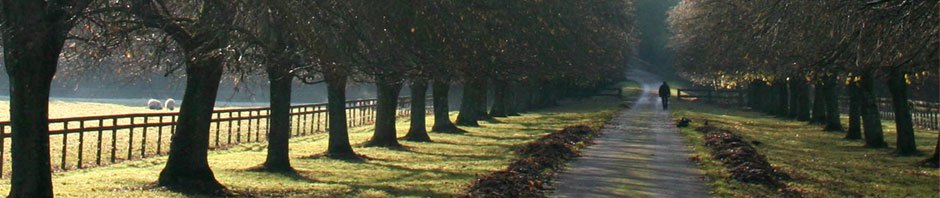
29. Pass through the gate, cross the lane & through another gate into the next section of the park. Again the path is well marked up the hill past some magnificent lime trees…

Continue in the same direction, passing another cairn

30. When you get a clear view stop & admire Dallam Tower House away to the left…

A ‘pele’ tower was built on the site in about 1375, but demolished when the present house was built in 1720–23. A plan dated 1614 indicates that at that time there was a house with formal gardens
The House is grade I listed country house but is not open to the public except for occasional charity events. It’s also a wedding venue
31. Turn around & walk back to the stone cairn & this time take the slightly diagonally path to the left…

Again the path across the field’s very well marked up past the magnificent trees & then a steep climb up to the top of the park

32. Past the trees at the top the past descends to a Ha Ha & a gate…

Walk through this & then down the wonderful of avenue of trees to the bottom of the next field

33. Exit the field through the gate…

…where you’ll find yourself back in the car park of the Corn Mill where we started this walk
Well, what another stunning walk in such a beautiful, unknown part of the country. It’s a great one to do along with the others I’ve done in this area.
Go Walk!